The Founding Landscape
A living demonstration of regenerative stewardship.
The first step toward the Regenerative Stewardship Sanctuary™ vision is a small pilot landscape — a place where ecological restoration, wildlife habitat creation, and community learning can begin. This Founding Landscape will serve as proof of concept: tangible evidence that regenerative stewardship works, that degraded land can heal, and that communities are ready to participate in the process.
Why a 5-Acre Pilot
Large conservation campuses often begin with small demonstration landscapes that show what is possible — building credibility, refining methods, and inspiring the next phase of growth.
Ecological Restoration
Demonstrate how degraded or underused land can be returned to ecological health through science-based, community-engaged restoration practices.
Wildlife Habitat Enhancement
Create connected habitat corridors, nesting sites, and foraging areas that support native birds, pollinators, and mammals.
Native Plant Establishment
750–900 native trees and shrubs planted to form the foundation of a self-sustaining, biodiverse landscape.
Pollinator Habitat
Dedicated meadows of native wildflowers and grasses designed to support pollinators throughout the growing season.
Community Education
Hands-on workshops, school programs, and public events that connect people with the practice of ecological stewardship.
Research & Monitoring
Systematic ecological monitoring documenting changes in biodiversity, soil health, water quality, and wildlife activity.
Landscape Design
Every zone serves a purpose — ecological, educational, and communal. The design mirrors the principles of the full 160-acre sanctuary at a scale that can be achieved in Year One.
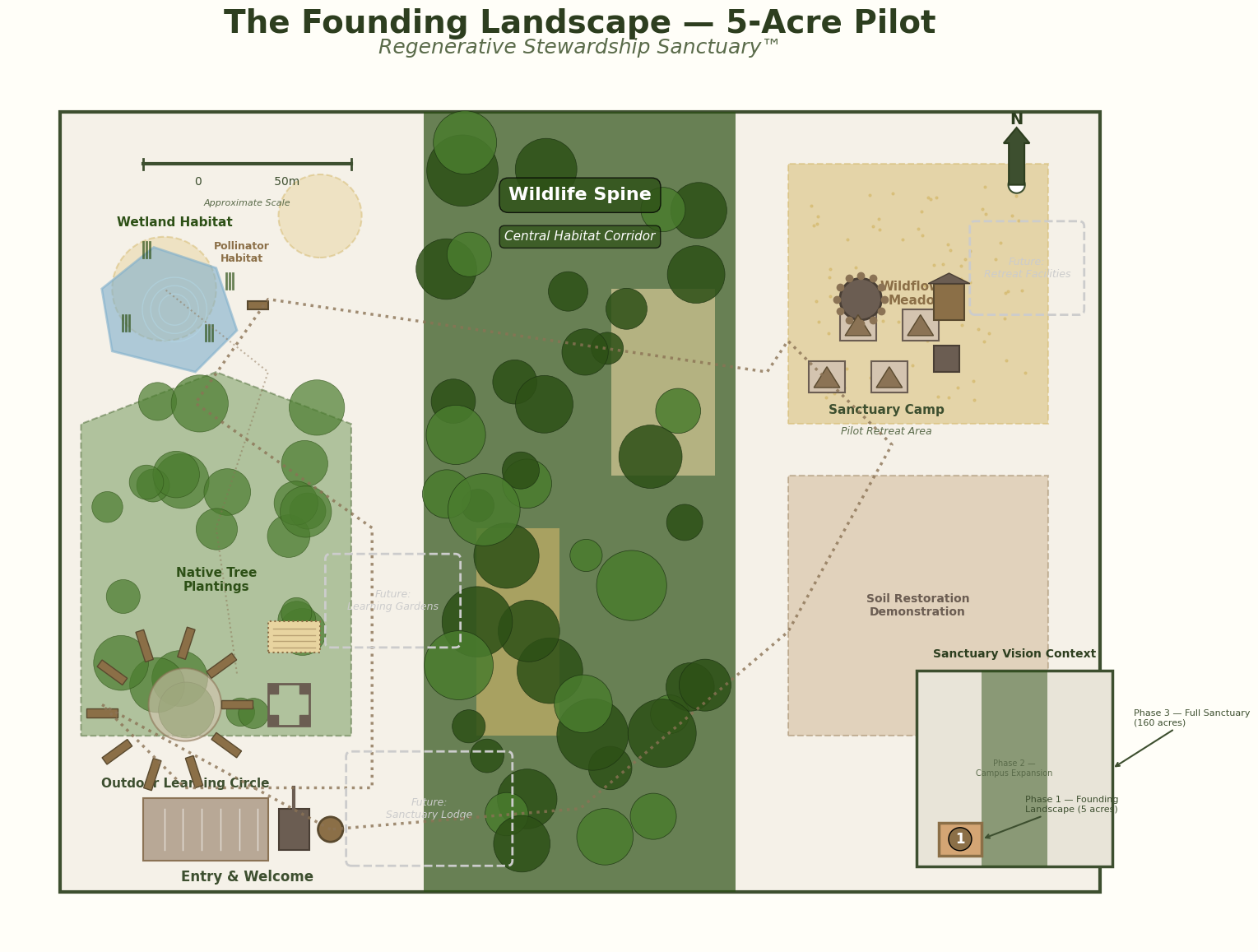
The Founding Landscape represents the pilot phase of the Regenerative Stewardship Sanctuary™, focusing first on habitat restoration, ecological learning, and low-impact retreat experiences. This initial landscape establishes the Wildlife Spine corridor and restoration zones that will guide the sanctuary's long-term development.
Conceptual diagrams and site plans represent the current planning vision for the Regenerative Stewardship Sanctuary™ and may evolve as ecological planning, partnerships, and site-specific assessments develop.
Wildlife Spine Corridor
A central biodiversity corridor running through the heart of the site — the ecological backbone supporting safe wildlife movement, native forest regeneration, and habitat connectivity.
Pollinator Meadow
A vibrant expanse of native wildflowers and grasses providing season-long nectar and pollen sources for bees, butterflies, and other essential pollinators.
Native Tree Plantings
Strategic plantings of native trees and shrubs — white spruce, trembling aspen, saskatoon, chokecherry, and red-osier dogwood — forming canopy and understory layers.
Riparian Restoration
If a creek, wetland, or seasonal waterway is present, the riparian zone receives focused restoration — stabilizing banks, planting moisture-loving native species, and improving water quality.
Community Garden
A small-scale demonstration of regenerative food production — raised beds, companion planting, and composting systems that model how communities can grow food while building soil.
Outdoor Learning Circle
A natural gathering space with log seating arranged in a circle — designed for workshops, school visits, community conversations, and quiet reflection.
“Restoration is not a project with an end date. It is a practice — a way of being in relationship with the land that sustains us.”
What Will Happen on the Founding Landscape
Four streams of activity will unfold simultaneously — each reinforcing the others, each building evidence of what regenerative stewardship can achieve.
Restoration
Native grasses, trees, and shrubs planted to restore ecological function. The restoration follows a phased approach — pioneer species first to stabilize soil and create shelter, followed by a diverse mix of native trees, shrubs, and groundcover that builds toward a self-sustaining ecosystem.
- 750–900 native trees and shrubs
- Native grass and wildflower seeding
- Soil health restoration through organic amendments
- Two-year dripline irrigation for establishment
Wildlife Habitat
Habitat structures and natural corridors supporting birds, pollinators, and mammals. The landscape is designed around wildlife needs — not as an afterthought, but as a central organizing principle.
- Nesting boxes and bat houses
- Brush piles and wildlife shelters
- Pollinator meadow with season-long bloom
- Connected habitat corridors for safe movement
Education
Hands-on workshops for restoration, stewardship, and nature connection. The Founding Landscape becomes a living classroom where people of all ages learn by doing — planting, monitoring, observing, and reflecting.
- Restoration planting workshops
- Wildlife identification walks
- Soil health and composting programs
- School group and youth stewardship days
Monitoring
Ecological monitoring to measure improvements in biodiversity and soil health. Every restoration action is documented, creating a body of evidence that demonstrates what regenerative stewardship can achieve.
- Baseline biodiversity assessment
- Soil carbon and health testing
- Wildlife activity surveys
- Photo monitoring stations
The Sanctuary Experience
From arrival to departure, visitors move through a structured journey of learning, restoration, community, and reflection.
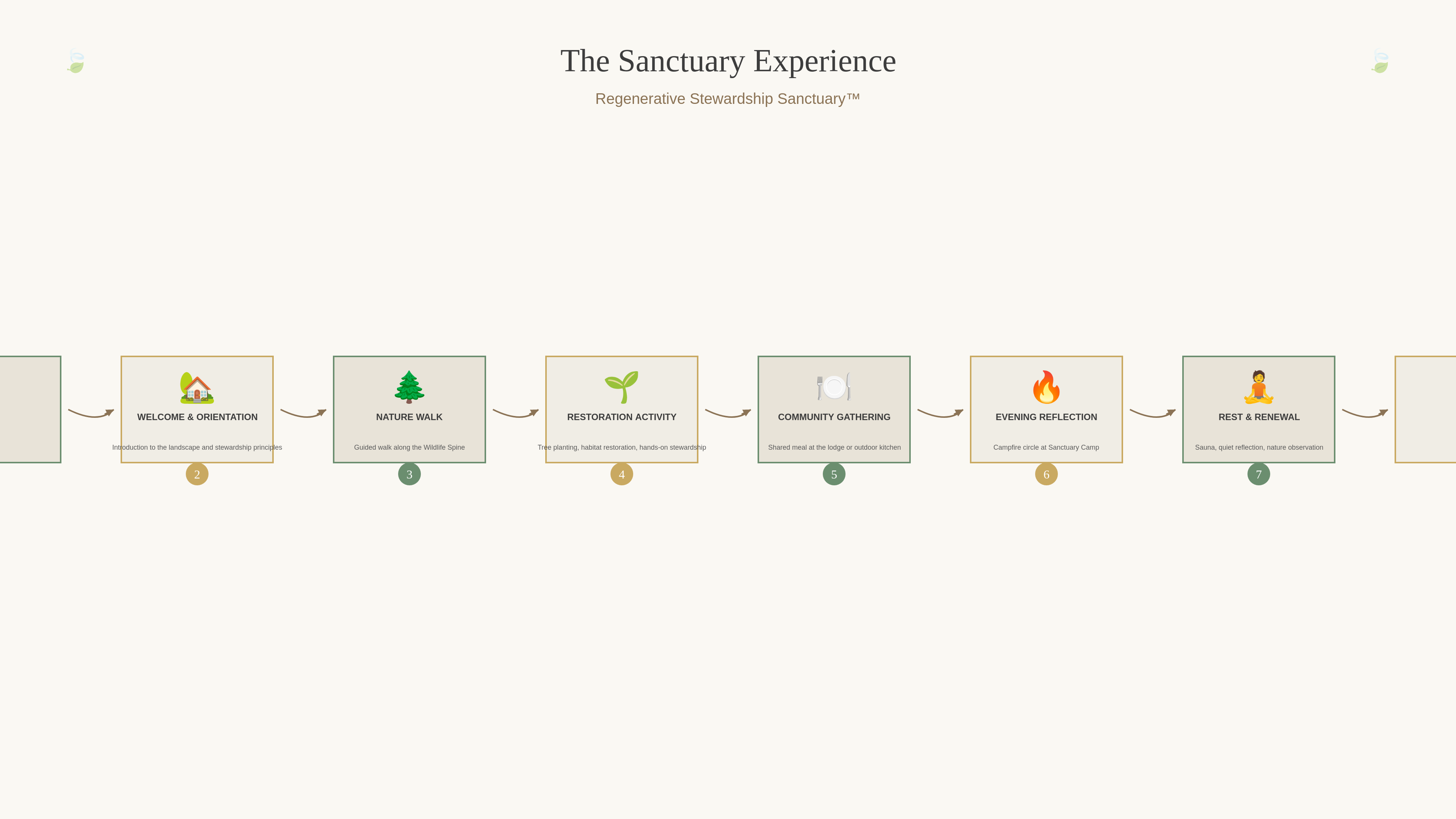
A day in the life at the Regenerative Stewardship Sanctuary — meaningful engagement with land, community, and self.
Conceptual diagrams and site plans represent the current planning vision for the Regenerative Stewardship Sanctuary™ and may evolve as ecological planning, partnerships, and site-specific assessments develop.
Proof That Restoration Works
The Founding Landscape will demonstrate — in a tangible, measurable way — how regenerative stewardship can restore land while building community connection. It will show that ecological restoration is not an abstract ideal, but a practical discipline that produces real, documented results.
Every tree planted, every species observed, every workshop delivered, and every soil test completed will add to a growing body of evidence — evidence that can inspire replication, attract additional support, and demonstrate the viability of the larger sanctuary vision.
In a time when ecological degradation feels overwhelming, the Founding Landscape offers something powerful: a beginning.
The Beginning of a Larger Vision
The Founding Landscape represents the first step toward a larger sanctuary campus — a 160-acre living landscape where land, wildlife, and people regenerate together. What begins on five acres will grow, season by season, phase by phase, into a regional centre for ecological restoration, environmental education, and community stewardship.
Every great landscape begins with a single planting. This is ours.