
160-Acre Regenerative Landscape
A landscape organized around a central principle: wildlife movement comes first.
The Sanctuary Framework
A bird's-eye view of how the Regenerative Stewardship Sanctuary™ organizes ecological restoration, learning, and retreat within a single connected landscape.
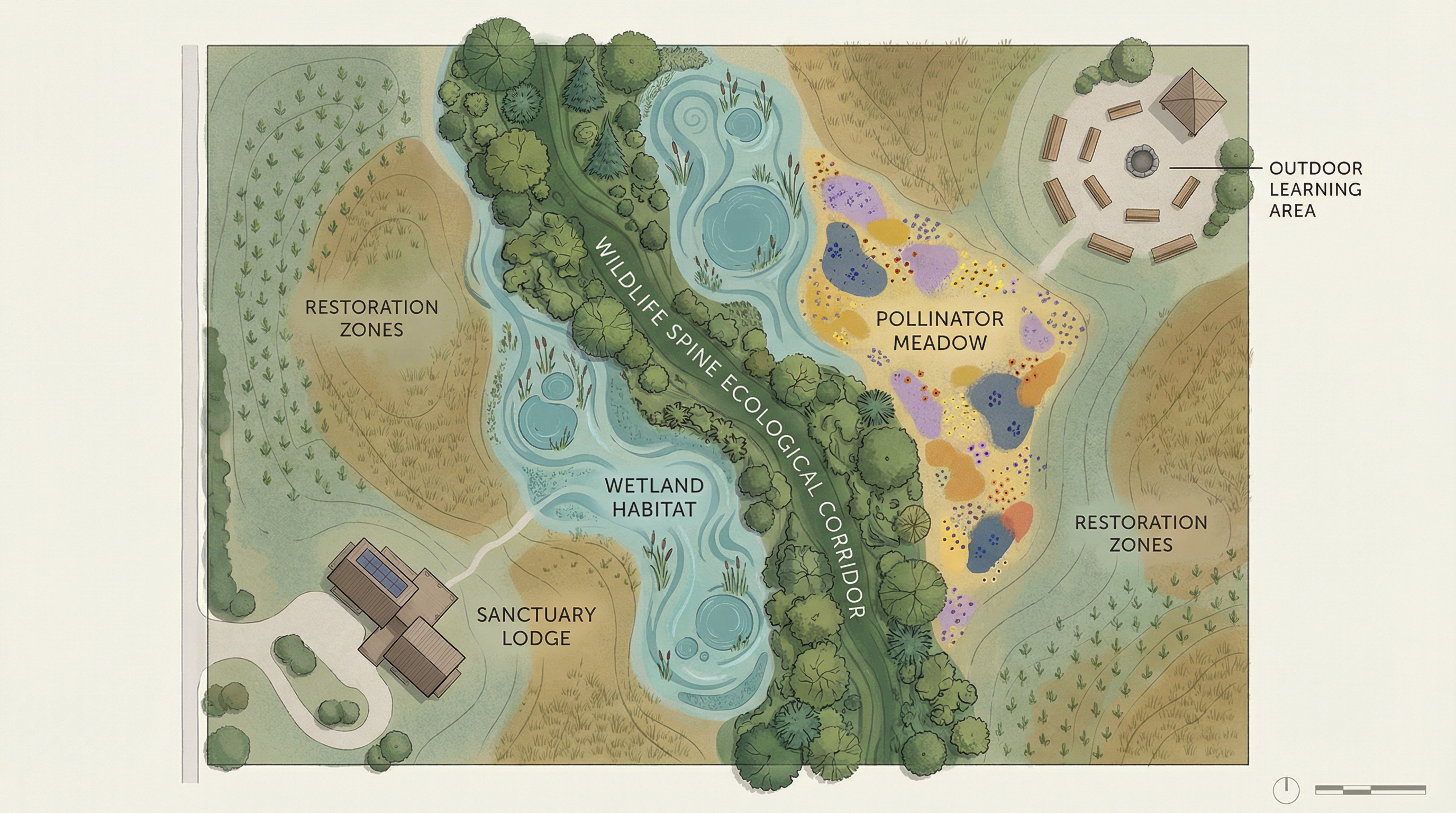
The Regenerative Stewardship Sanctuary™ is organized around a central Wildlife Spine corridor that supports wildlife movement and habitat restoration. Learning spaces and retreat areas are intentionally placed alongside this living landscape.
Conceptual diagrams and site plans represent the current planning vision for the Regenerative Stewardship Sanctuary™ and may evolve as ecological planning, partnerships, and site-specific assessments develop.
Central Biodiversity Corridor
At the heart of the Sanctuary's physical design is the Wildlife Spine—a central biodiversity corridor that runs the length of the property, connecting diverse habitat zones and providing uninterrupted passage for wildlife.
The landscape is organized so that human activity areas—learning spaces, gathering areas, walking paths—are situated at the edges, with the Wildlife Spine and core habitat zones occupying the center.
“We do not place nature at the margins of human activity. We place human activity at the margins of nature.”

Six Interconnected Zones
The 160-acre quarter section is organized into distinct zones, each serving ecological and educational functions while preserving the integrity of the Wildlife Spine.
Wildlife Spine
Central Ecological Corridor
The ecological backbone—a wide corridor running through the heart of the property enabling safe wildlife movement and habitat connectivity. Includes native forest regeneration, wetlands, pollinator meadows, and wildlife habitat structures.
Zone 1: Restoration Landscape
Native Prairie & Reforestation
Occupying the majority of the sanctuary footprint. Native prairie restoration, pollinator meadow establishment, wetland and riparian restoration, reforestation patches, and soil regeneration zones.
Zone 2: Learning Campus
Outdoor Classrooms & Workshops
A compact campus near the property edge where the Academy programs operate. Outdoor classrooms, central gathering circle, workshop pavilion, demonstration gardens, and certification training spaces.
Zone 3: Food Forest & Regen Ag
Permaculture & Demonstration
Multi-layer food forest ecosystem, permaculture garden demonstrations, regenerative agriculture trial plots, composting systems, and greenhouse for plant propagation.
Zone 4: Nature & Wellbeing
Meditation, Retreat & Forest Bathing
Quiet zones for personal reflection, mindfulness, and deep connection with the natural world. Forest meditation grove, contemplation trails, observation decks, and forest bathing paths.
Trails & Interpretive Network
Connecting All Zones
A thoughtfully designed trail network connecting all zones while preserving wildlife corridor integrity. Looping walking trails, observation points, interpretive learning stops, and accessible design.
Total Area
160 acres
Dimensions
~2,640 ft × 2,640 ft
Quarter Section
Full
Status
Conceptual Master Plan
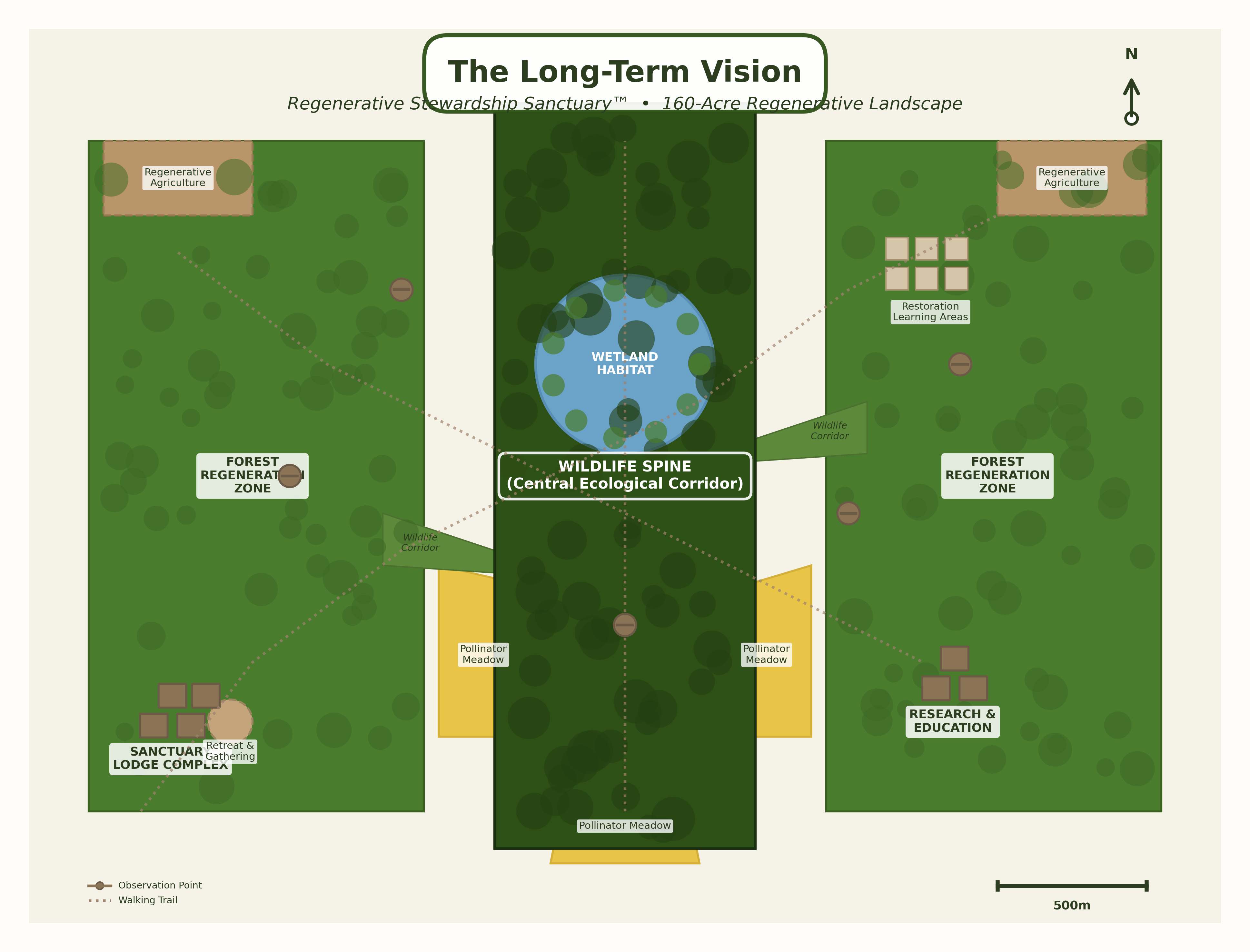
The Long-Term Vision — 160-acre regenerative landscape organized around the central Wildlife Spine ecological corridor.
Conceptual diagrams and site plans represent the current planning vision for the Regenerative Stewardship Sanctuary™ and may evolve as ecological planning, partnerships, and site-specific assessments develop.
Rebuilding Ecological Function
Systematic ecological restoration through practices grounded in science and informed by place. The approach addresses the landscape as a whole—understanding that healthy soils support healthy watersheds, which support diverse communities.
Wetland Restoration
Recovering degraded wetland systems to restore water filtration, flood attenuation, and amphibian habitat.
Soil Regeneration
Rebuilding soil biology through composting, cover cropping, mycorrhizal inoculation, and eliminating chemical inputs.
Native Tree Planting
Diverse native canopy and understory species with attention to genetic diversity and regional ecosystem fit.
Pollinator Habitat
Creating wildflower meadows, nesting sites, and year-round forage for native bees, butterflies, and other pollinators.
Wildlife Corridors
Continuous habitat connections enabling wildlife movement between the Sanctuary and surrounding landscapes.
Watershed Stewardship
Managing water flow through bioswales, rain gardens, riparian buffers, and responsible drainage design.
“Healthy soils build healthy watersheds. Healthy watersheds build healthy communities. The work is all one work.”

See how this vision begins with a 5-acre demonstration landscape.
Explore the Pilot Project